

A certificate of analysis, usually shortened to COA, is the document that separates a
tested product from an untested one. Ours are issued by Janoshik Analytical,
an independent laboratory that receives the sample directly and has no stake in the result.
If you have never read one before, the layout can look dense. It is actually only five
pieces of information, and once you know where they sit you can assess any report in
about thirty seconds.
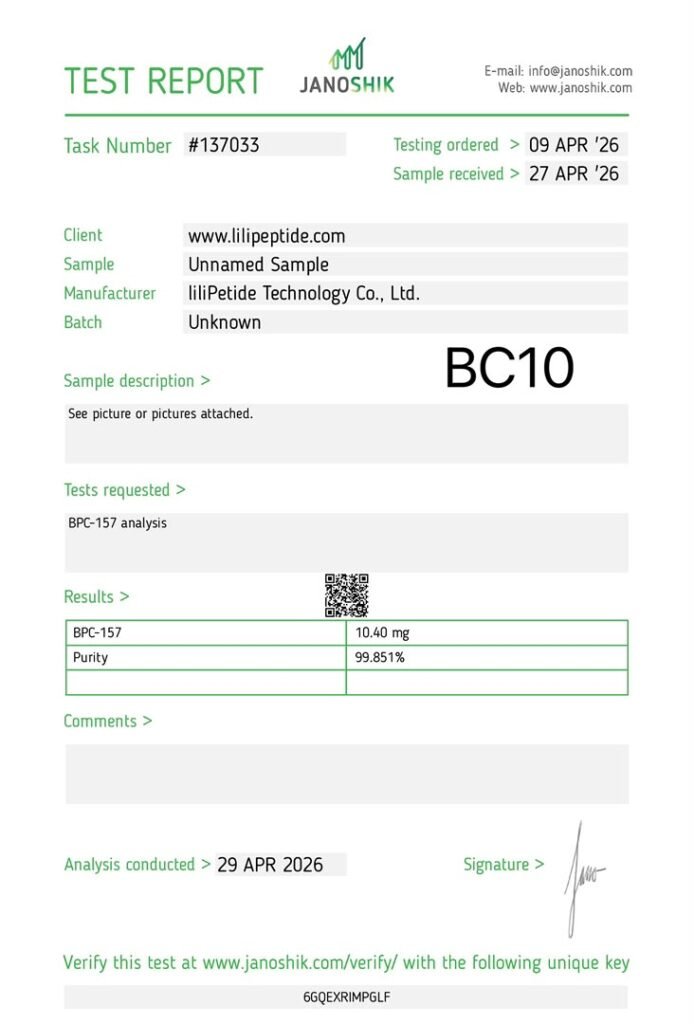
The header: what was tested and when
The top block records the chain of custody. The task number is the
laboratory’s own reference for that specific submission. Below it sit two dates:
testing ordered and sample received. These are deliberately separate,
because the laboratory logs the sample when it physically arrives, not when it was paid for.
A third date, analysis conducted, appears near the bottom.
The client and manufacturer fields identify who
submitted the material. On our reports the client reads as our own domain, which is what
you want to see: it means the vials were sent for testing by the seller rather than a
report being borrowed from elsewhere.
The sample code
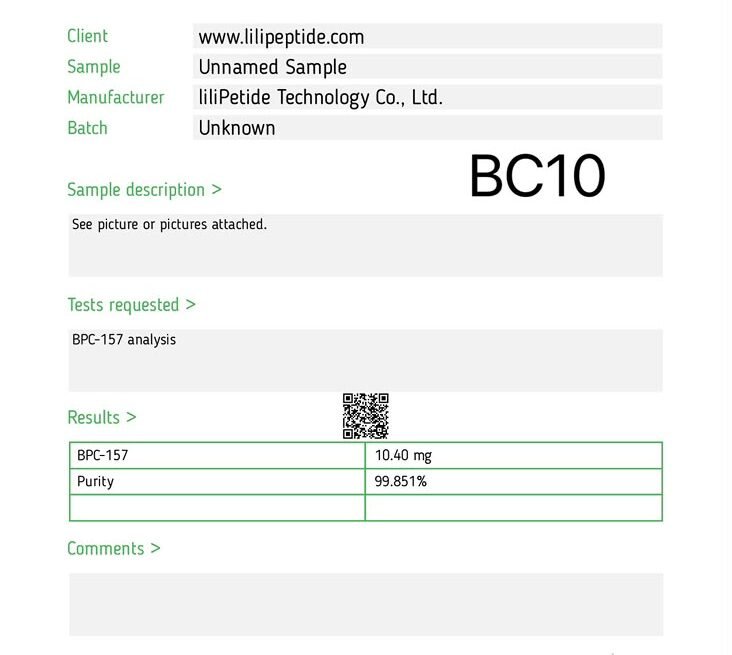
The large code printed on the right of the page, such as BC10 or
RT30, identifies which item in the range the vial came from. The pattern is
consistent across our catalogue: the letters identify the compound and the number is the
strength in milligrams. BC10 is BPC-157 at 10 mg, BT10 is
TB-500 at 10 mg, RT30 is Retatrutide at 30 mg. Where a report covers
a blend the code reflects the total, so BBG70 is a 70 mg blend.
Results: content and purity are not the same number
This is where most misreadings happen. A report typically gives two separate figures,
and they answer different questions.
Content is the mass of the target compound the laboratory recovered
from the vial, expressed in milligrams. Purity is the proportion of the
recovered material that is the target compound rather than related substances.
Take our BPC-157 10 mg report. It records 10.40 mg of content
at 99.851% purity. The content figure sitting slightly above the labelled
10 mg is normal and expected: vials are filled with a small overage so that the stated
quantity survives the filling process. A figure meaningfully below the label would
be the thing to question.
Some reports carry a third line. Growth hormone reports add dimer and related
proteins, which measures aggregation. HCG is reported in international units rather
than milligrams, because that is how the material is standardised.
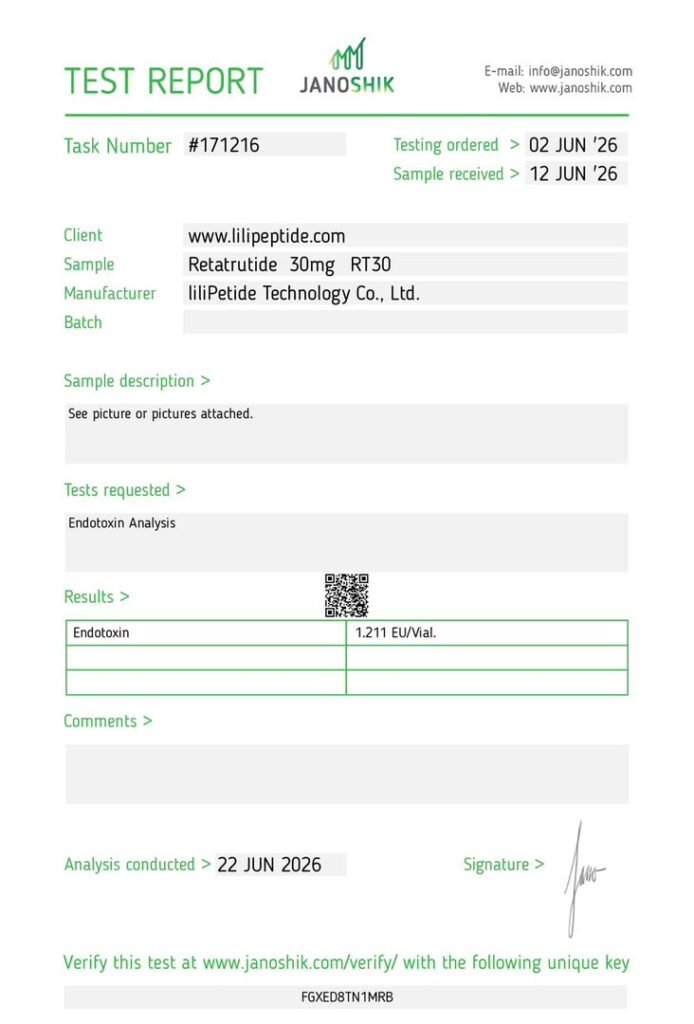
Endotoxin is a separate test
Purity and endotoxin measure unrelated things, so they are ordered separately. A purity
assay tells you what proportion of the material is the target compound. An endotoxin assay
measures bacterial endotoxin, reported in endotoxin units per vial. Our Retatrutide
30 mg endotoxin report returns 1.211 EU per vial. Because it is a
distinct test, a purity report will not carry an endotoxin figure and vice versa – if you
want both, you look for two reports.
The verification key
The most important line on the page is the last one. Every Janoshik report ends with a
unique key, printed in the grey box at the foot of the document. Enter that key at
janoshik.com/verify
and the laboratory will return the report it holds on file for that key.
This matters because an image of a document proves nothing on its own. The verification
key is what makes a report checkable against the laboratory rather than against the seller.
We publish the keys precisely so they can be used – you are not expected to take our word
for the numbers.
Where to find ours
Reports appear in two places on every product that has them. They sit in the image
gallery alongside the product photographs, and they appear in full under the
Lab Test tab further down the page, where each one is captioned with the
strength it covers. That caption matters on products such as Tirzepatide, where seven
reports cover seven different strengths and the scans otherwise look near-identical.
All products are for laboratory research use only and are not for human or veterinary use.

We use cookies to improve your experience. By continuing, you agree to our cookie policy.
I AcceptYour Cart
Add $500.00 more to get free shipping!
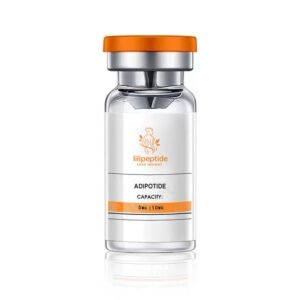
Adipotide
Price range: $210.00 through $230.00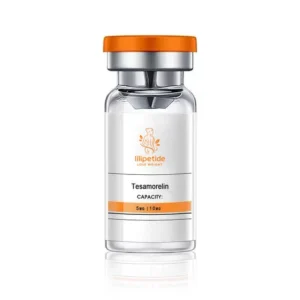
Tesamorelin
Price range: $136.00 through $257.00
Make up the difference
Price range: $2.00 through $1,000.00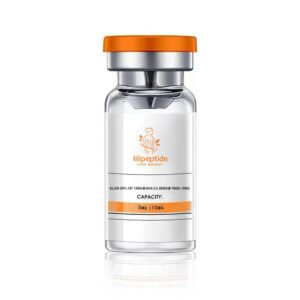
GLOW70(BPC157 10mg+GHKCU 50mg+TB500 10mg)
Original price was: $280.00.$256.00Current price is: $256.00.All Categories
Search
Adipotide
Price range: $210.00 through $230.00Tesamorelin
Price range: $136.00 through $257.00Make up the difference
Price range: $2.00 through $1,000.00